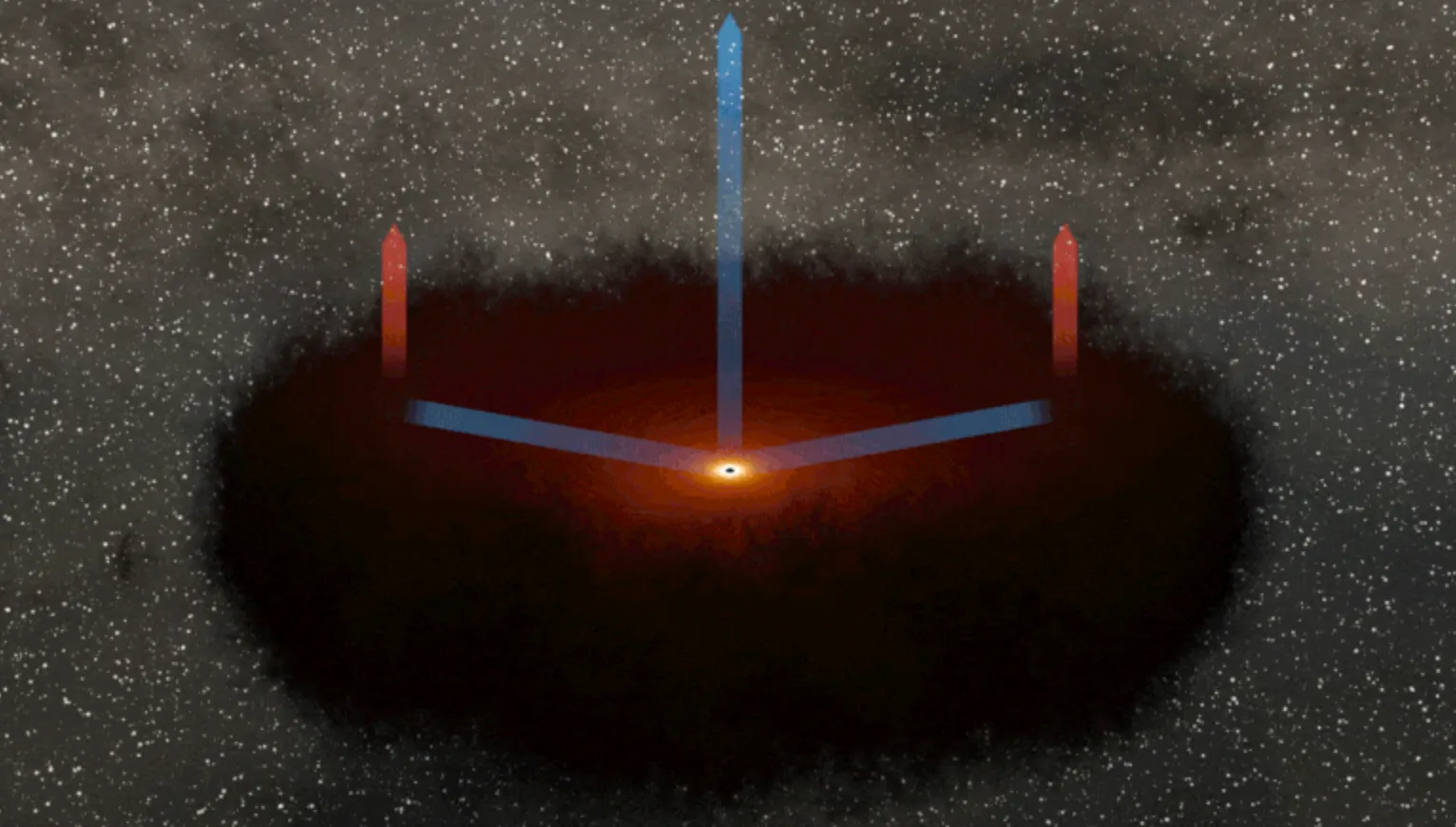
Reverberation and the disk–corona connection
How the X-ray corona heats the accretion disk and drives the ultraviolet and optical variability we see in active galactic nuclei. I develop the physical models that turn these delayed echoes into a picture of the innermost accretion flow.
Overview
In active galactic nuclei, the X-ray corona and the accretion disk are not independent: the corona illuminates the disk, heats it, and drives the ultraviolet and optical variability we observe. Because the reprocessed light arrives with a delay that grows with wavelength, these “echoes” carry information about the geometry and physics of the innermost accretion flow. Reading that information requires a model of how the disk absorbs, thermalizes, and re-emits the X-rays, with all the relativistic effects of the black hole’s gravity included.
Approach
With Michal Dovčiak and Iossif Papadakis, I develop physical models of this disk–corona system. KYNxiltr predicts the wavelength-dependent time lags from an X-ray-illuminated relativistic disk, including disk ionization and full general relativity, together with an analytic prescription that can be fit directly to observed lag spectra. Its companion, KYNSED, models the broadband spectral energy distribution self-consistently, treating the energy exchange between the disk and corona so that the two are balanced rather than assumed independent.
Key results
- X-ray illumination of the disk reproduces the observed UV/optical time-lag spectra of nearby Seyferts once relativistic effects and disk ionization are taken into account.
- The same framework has been applied across several well-monitored sources, including NGC 5548, NGC 4151, and Fairall 9, describing both their time lags and their broadband spectral energy distributions.
- Extending the model to a large sample of quasars, I showed that X-ray illumination of the disk also reproduces the long-observed correlation between their ultraviolet and X-ray luminosities.
Related publications
See my full publication list for the papers behind this work.