High-resolution X-ray spectroscopy in the XRISM era
XRISM now resolves the iron lines in active galactic nuclei finely enough to separate the gas moving at different speeds around the black hole. I use this to map the inner disk, the broad-line region, and the obscuring gas that earlier telescopes blurred together.
Overview
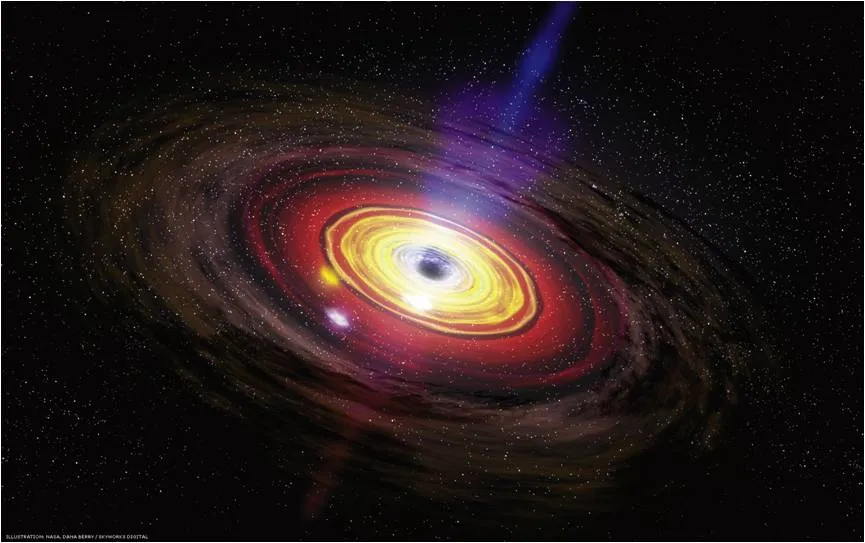
For decades, the iron features that carry so much information about the gas around a black hole were smeared together by the limited resolution of X-ray detectors. The microcalorimeter on XRISM changed that. It resolves the iron K complex finely enough to separate its components by their motion, letting us pick apart the inner accretion disk, the broad-line region, and the more distant obscuring gas that used to blend into a single blur.
Approach
I lead several XRISM Guest Observer programs that use this new resolving power to study the structure of the gas around accreting supermassive black holes, supported by simultaneous XMM-Newton, NuSTAR, and optical observations. The programs target the X-ray broad-line region, the fine structure of the iron line in individual sources, and the separation of components in dual-AGN candidates.
Key results
- In NGC 7213, XRISM resolves the iron emission into a narrow core, a broader disk-like component, and highly ionized lines whose locations bridge the inner disk and the optical broad-line region, revealing a radially stratified structure that was invisible before.
- Applied across nearby AGN, these high-resolution spectra are reshaping how we picture the multiple phases of gas surrounding a growing black hole.
Related publications
See my full publication list for the papers behind this work.