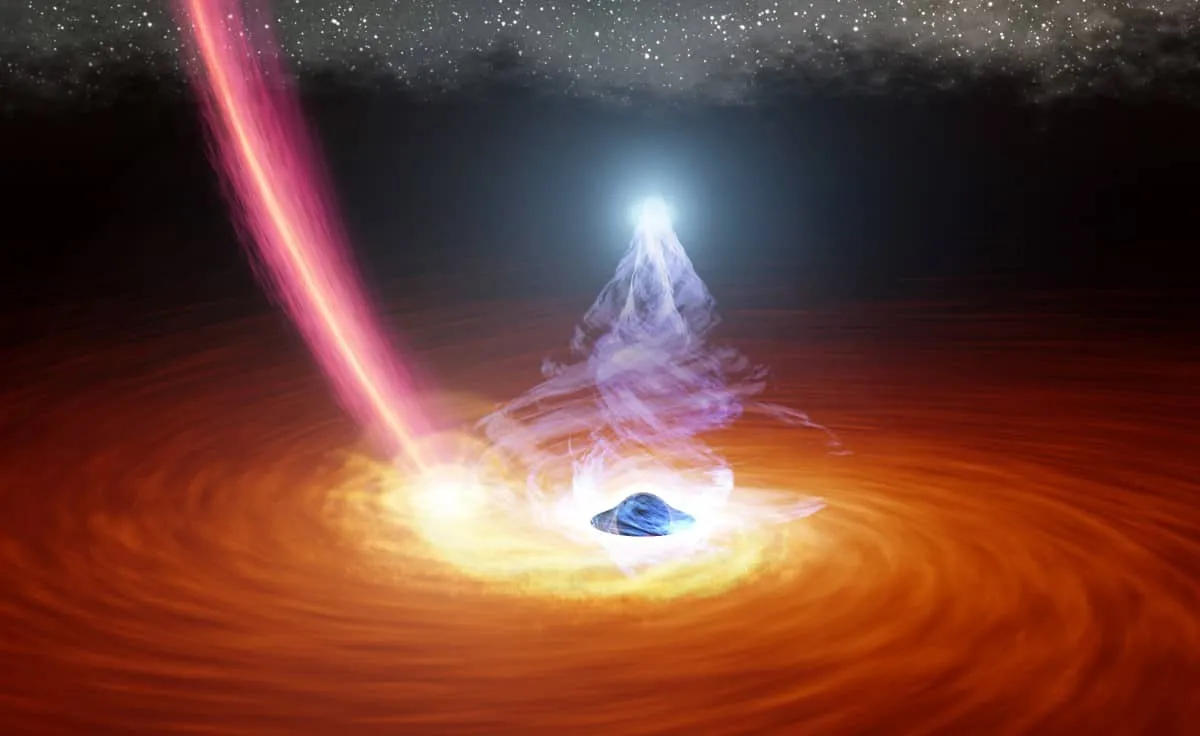
X-ray polarimetry of active galactic nuclei
Since 2021, IXPE has let us measure the polarization of X-rays from active galactic nuclei, a completely new handle on the geometry of the innermost regions. I use it to work out where the X-rays come from and how much of what we see is reflection off the disk.
Overview
X-ray spectra alone struggle to pin down the shape of the corona, since very different geometries can produce nearly identical spectra. Polarization breaks that impasse. The degree and angle of polarization depend directly on how the emitting and scattering material is arranged, so measuring them tells us something spectroscopy cannot. The launch of IXPE in 2021 finally made this possible.
Approach
I combine IXPE polarization measurements with broadband spectroscopy from XMM-Newton and NuSTAR, and fit them together with physical models of the disk and corona. The goal is to separate the light that comes straight from the corona from the light that has reflected off the accretion disk, and to use both to constrain the geometry of the central engine.
Key results
- For NGC 4151, the brightest and best-studied case, I showed that reflection off a disk illuminated by a compact corona can account for the observed polarization, offering an alternative to the extended-corona interpretation proposed earlier.
- The same model fits the polarization and the broadband spectrum at once, showing that disk reprocessing can explain both together rather than requiring separate stories for each.
Related publications
See my full publication list for the papers behind this work.