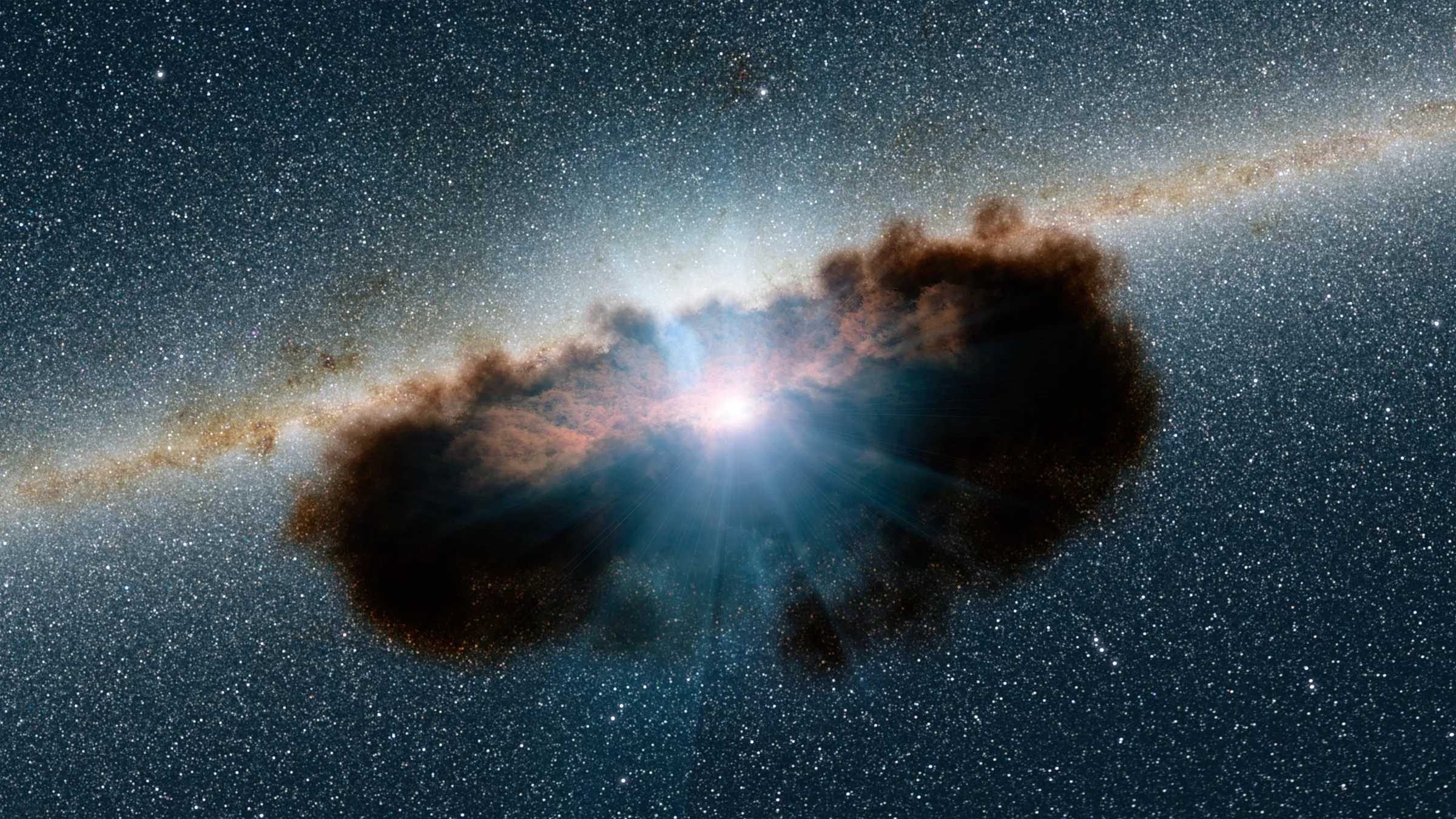
AGN obscuration and X-ray eclipses
A lot of black holes are hidden behind thick gas and dust, and that gas is often on the move. I use hard X-rays to see through it, and passing clouds that briefly eclipse the source to measure how the obscuring material is arranged.
Overview
Much of a black hole’s surroundings is wrapped in gas and dust thick enough to block our view at most wavelengths. Hard X-rays are one of the few probes that get through, which makes them essential for finding the most heavily buried black holes and measuring what lies behind the obscuration. And because that gas is clumpy and moving, clouds sometimes drift across our line of sight and briefly eclipse the X-ray source, giving us a way to measure the size and location of the material directly.
Approach
I use the hard X-ray reach of NuSTAR, together with XMM-Newton and Chandra, to characterize obscured active galactic nuclei one source at a time and as a population. I also model the spectral and polarization changes that happen during an eclipse, which turn a passing cloud into a probe of the innermost regions.
Key results
- As part of a NuSTAR legacy program with Jon Miller, I led a hard X-ray study of a complete sample of nearby obscured Seyfert galaxies drawn from the CfA survey, finding that most are heavily buried and a large fraction are Compton-thick.
- Combining NuSTAR with softer X-ray data, I confirmed that one of these galaxies, NGC 5347, hosts a heavily buried, Compton-thick black hole that earlier observations had struggled to classify.
- In the changing-look galaxy NGC 7582, time-resolved spectroscopy tracked clouds crossing the line of sight, placing them within about half a parsec of the black hole and moving faster than 700 km per second.
- Modeling how spectra and polarization change during an eclipse shows that these events can map the geometry of the innermost accretion flow, a technique that future X-ray missions will be able to exploit.
Related publications
See my full publication list for the papers behind this work.