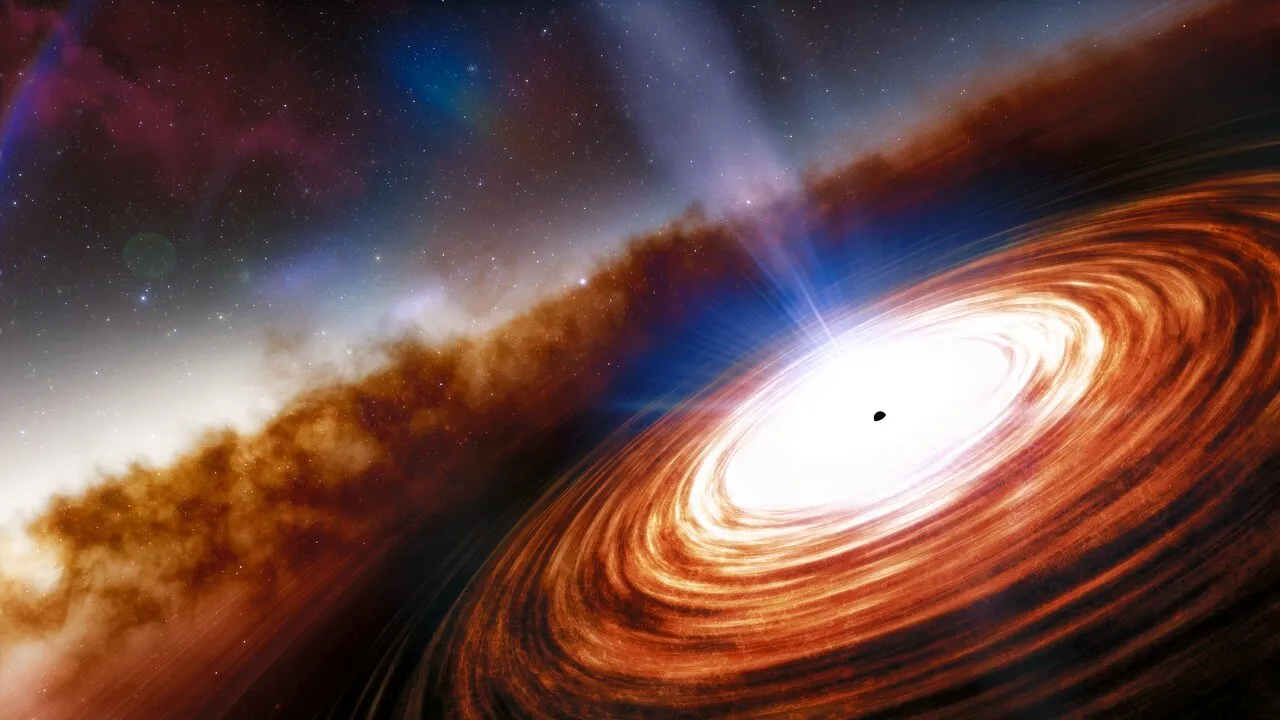
Luminous and high-redshift quasars
Most of what we know about black hole coronae comes from nearby, modest galaxies. I push the same measurements out to the brightest quasars in the universe, to test whether the physics we worked out locally still holds at the extremes.
Overview
Our detailed picture of how X-rays are produced around black holes comes mostly from nearby, relatively low-luminosity galaxies. The most luminous quasars, often far across the universe and growing at a furious rate, are a much harder test. Deep X-ray observations of these sources ask a simple question: does the physics of the corona and the accretion disk that we established locally still apply where the black holes are a billion times the mass of the Sun and shining near their limit?
Approach
I run coordinated observing campaigns with NuSTAR, XMM-Newton, Chandra, and Swift to measure the temperature and density of the corona in luminous quasars, and to follow how these sources vary over months and years. Combining hard and soft X-rays lets me pin down properties that a single telescope cannot reach.
Key results
- I led the first X-ray look at SMSS J1144, the most luminous quasar of the last nine billion years, measuring its coronal properties and finding a compact corona and clear signs of an outflow driven by radiation pressure.
- For the luminous quasar QSO B2202, I showed that its corona looks much like those of nearby, far less massive galaxies, evidence that the same basic process operates across an enormous range of black hole mass and luminosity.
- This work is part of larger efforts, including the PACHA and WISSHFUL programs, to build up a picture of black hole coronae in the early, high-luminosity universe.
Related publications
See my full publication list for the papers behind this work.